
How Much Does Well Cleaning Cost in Maryland?
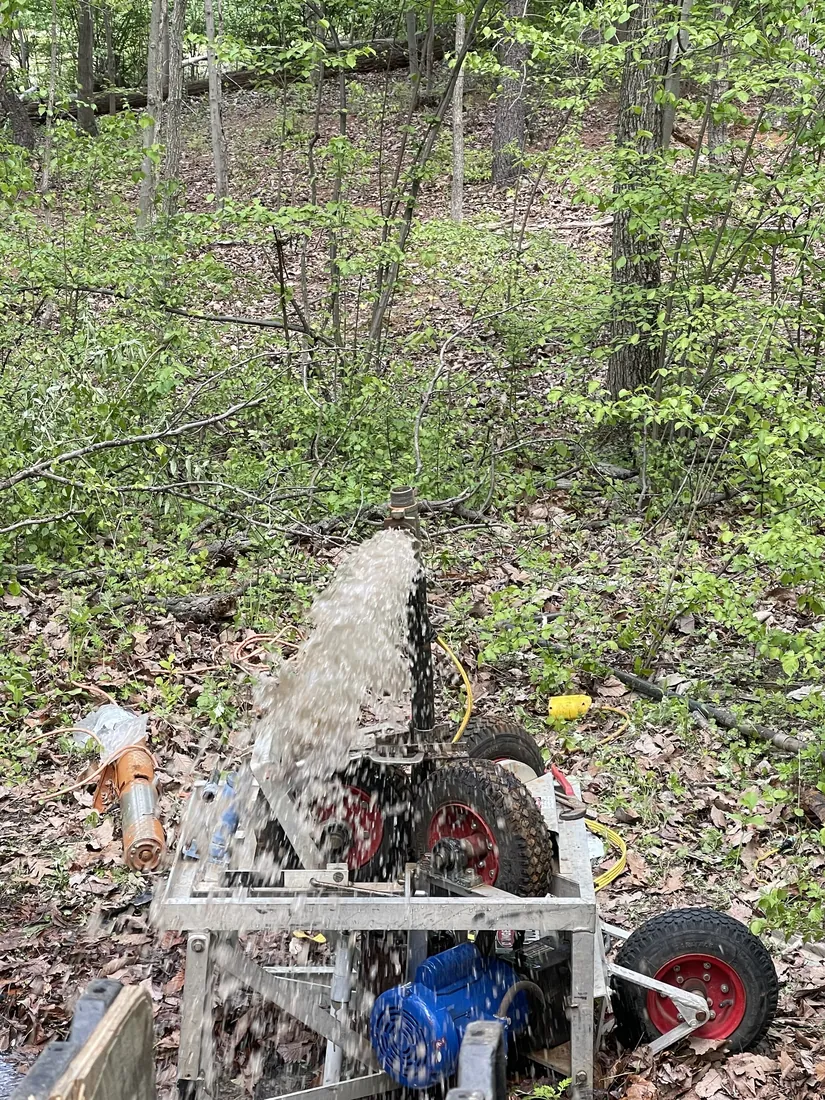
A Southern California well company’s published price guide puts mechanical well cleaning at $1,500 to $4,000. A well equipment company’s 2026 cost comparison puts well rehabilitation at $1,000 to $8,000. Neither is a HydroWells quote. For well cleaning and rehabilitation, our crew airlifts, surges and jets iron deposits and sediment out of the well.
Well cleaning is work on the well itself. Iron deposits, bacterial slime and sediment build up on the casing and in the rock fractures that feed the well. The water slows down. A cleaning job breaks that buildup loose and pumps it out. Every dollar figure below is published market data with its source noted, and none is a HydroWells price. We are based in Poolesville and Dickerson and serve Montgomery, Frederick, Carroll, Howard, Washington and Baltimore County.
What do published guides say well cleaning costs?
Published rehabilitation work typically falls between $1,000 and $8,000, a well equipment company’s 2026 comparison says. Mechanical cleaning alone lands at $1,500 to $4,000 in a Southern California well company’s guide. Crew time, a yield test and a lab sample add their own lines.
The two biggest ranges measure different jobs. The $1,500 to $4,000 figure covers mechanical cleaning only. That is how we clean wells, by airlifting, surging and high-pressure jetting. The $1,000 to $8,000 range runs wider because its top end includes hydrofracturing and more extensive work. HomeGuide puts a two-person well repair crew at $150 to $300 per hour. Pulling and resetting the pump is crew time. Disinfection after the work is its own step, and our coliform bacteria guide lists the published shock chlorination prices.
Published market ranges, not a HydroWells quote
| Part of the job | Published range | Who published it |
|---|---|---|
| Mechanical cleaning: brushing, jetting, surging, bailing, airlifting | $1,500 to $4,000 | A Southern California well company’s price guide |
| Well rehabilitation, typical job | $1,000 to $8,000 | A well equipment company’s 2026 cost comparison |
| Surging or a simple chemical treatment | $1,000 to $3,000 | The same 2026 cost comparison |
| Well repair crew time, such as the pump pull and reset | $150 to $300 per hour, two-person crew | HomeGuide |
| Yield test | $400 to $800 | The same Southern California price guide |
| Lab sample at a certified mail-in lab | $50 to $100 | The Well Guide |
What drives the price of a well cleaning job?
What is clogging the well, how deep it is and the cleaning method drive the price. Pulling the pump and the number of work days add labor. Disinfection, a lab sample and a yield check after the work add their own costs. A cleaning job starts with the well record.
Maryland drillers file a well completion report within 45 days of construction. That record shows the well’s depth and how it was built, so a quote can start from facts. Whatever clogs a well usually clings to the pump and pipe. The pump comes out on our hoist and gets looked over on the ground. Rehabilitation usually takes more than one day, and often several. Plan on water from another source, such as a hauled tank, while the well is down.
- Depth, which sets how much pipe comes out with the pump
- What is clogging it: iron deposits, slime, scale, silt or clay
- The method: airlifting, surging or high-pressure jetting
- Crew time to pull and reset the pump
- Disinfection of the well and water system afterward
- A lab sample and a yield check to measure the result
What are the signs a well needs cleaning?
Cloudy water, weaker flow from the pump and a positive total coliform test are signs a well needs cleaning. Those three come from industry well cleaning guidance. Penn State Extension adds a yardstick. A drop of 25 percent or more in well yield generally means rehabilitation is in order.
A well’s yield tends to drop as it ages, Penn State Extension notes. At the tap, water turns rusty, the sediment filter clogs fast and the pump brings up less. Waiting can raise costs, Penn State warns, and in some cases make rehabilitation impossible. Industry guidance calls for a yearly evaluation by a licensed or certified professional. A well inspection gives you that baseline.
Why do iron bacteria and sediment clog a well?
Iron bacteria produce a slime that holds iron deposits together, and that biofouling clogs well screens and pipes. Silt and clay settle in too and close off the openings that feed the well. USGS reports that iron and manganese are the most common groundwater quality problems in Maryland.
Iron bacteria are not known to cause disease, so the trouble is the clogging they cause. They are hard to confirm, since very few water labs test for them. Industry guidance lists the common cloggers: calcium carbonate, silt, clay, iron sulfides and bacterial biofouling. Cleaning takes that buildup out of the well. Iron that keeps arriving with the water is a treatment question. Our well water filtration cost guide covers those system prices.
Is cleaning, hydrofracking or a new well the right fix?
Cleaning is the right fix when buildup is choking a well that once made enough water. It gives back what the well made before. It cannot make the rock hold more water. When the rock itself makes too little, our hydrofracking cost guide lays out the published prices for the next options.
The 2026 cost comparison says rehabilitation is almost always the lower upfront investment. It adds that repeated rehab efforts can eventually exceed the cost of a new well. Penn State Extension says replacing a severely deteriorated well may cost less in the long run than rehabilitating it. If the rock is the limit, hydrofracking the bedrock is the next step to price.
Maryland sets the floor for a new domestic well at 1 gallon per minute for 6 hours. A cleaned well that still falls short of what the house needs may call for more than cleaning. The well record and a yield check after the work show which way a well is heading. The steps for a well worth saving are on our page about how we clean and redevelop a well.
What do Maryland rules say about well cleaning?
Maryland puts disinfection on whoever works on a well. After a cleaning, the well and the water supply system get disinfected. A casing found broken or unserviceable gets repaired and replaced, or the well is properly abandoned. Our well disinfection service handles the last step on our cleaning jobs.
Casing trouble changes the job and the price. Without a repair, the well gets sealed under state rules. Our well abandonment and sealing work covers that path. Yield gets checked too. We run the well after the flush and compare what it makes with what it made before. A certified lab sample covers the water side. Published lab fees are in our well water testing cost guide.
Water running rusty or slow? Call (301) 393-7090. We are open 24/7 and take calls nights, weekends and holidays. HydroWells is licensed through the Maryland State Board of Well Drillers. Estimates are free and written after a look at the property. You can also tell us what your well is doing.