
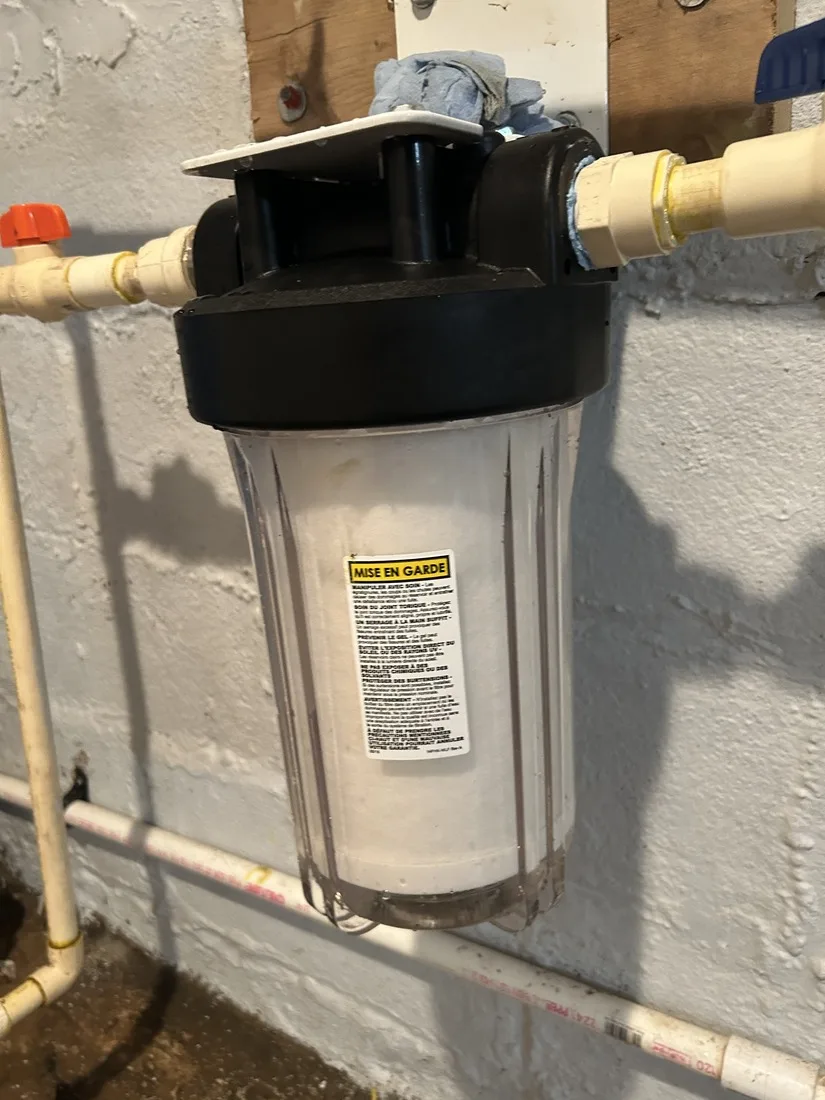
How Much Does a Well Water Filtration System Cost in Maryland?
One national cost guide puts a well water filtration system at $500 to $10,000 or more. Where you land depends on what your water test shows. Another guide puts a well water treatment system at $1,200 to $3,600 installed, with an average of $2,300. Our well water treatment and filtration is designed off your own lab report.
Orange stains in the tub and blue-green marks under a faucet both point to something in the water. A well water filtration system treats it where the water enters the house. The price follows how many stages your water needs. A single sediment filter sits at the low end, and a multi-stage system sits at the top.
Every dollar figure here is national market data from a published cost guide. Use the ranges as a yardstick when you read a quote, since your own number depends on your lab report. The water facts come from the Maryland Geological Survey, USGS and EPA. Our crew is based in Poolesville and Dickerson and works in Montgomery, Frederick, Carroll, Howard, Washington and Baltimore County.
What does a whole house water filtration system cost by type?
One national cost guide puts a sediment filter at $200 to $600 installed. It puts an iron and sulfur system at $1,500 to $4,000 installed. A carbon cartridge system runs $400 to $1,200 installed, and a multi-stage combination system $3,500 to $10,000 or more. The number of stages your water needs drives the total.
A second national guide lists sediment prefilters at $100 to $800 and carbon filters at $250 to $1,500. It puts iron filters at $900 to $4,000 and multi-stage packages at $2,500 to $10,000. The first guide says most well owners with average water spend $2,000 to $5,000 on a multi-stage system. Extras such as a new outlet or removal of old equipment can add to these figures.
Published national installed ranges by system type, from one national cost guide
| System type | What it handles | Published installed range |
|---|---|---|
| Sediment prefilter (single cartridge) | Sand, silt, rust and grit; always the first stage | $200 to $600 |
| Acid neutralizer (calcite tank) | Low pH that corrodes copper plumbing | $500 to $1,500 for the tank, plus $200 to $400 to install |
| Iron and manganese or sulfur filter | Orange or black staining and rotten-egg odor | $1,500 to $4,000 |
| Carbon or multi-cartridge system | Taste and odor; not iron, hardness or bacteria | $400 to $1,200 |
| Multi-stage combination system | Several stages plumbed in a set order | $3,500 to $10,000 or more |
What does Maryland well water usually need?
Maryland Piedmont well water tends to run acidic, and some wells carry iron and manganese above EPA’s secondary levels. Those findings point to a sediment prefilter plus an acid neutralizer, an iron filter or both. A softener goes in only where the lab finds hard water. The lab report sets the size.
A Maryland Geological Survey study sampled 25 Piedmont wells and found the groundwater acidic, with a median pH of 6.1. Seventeen of the 25 fell outside EPA’s secondary pH range of 6.5 to 8.5. Inside our service area, the Piedmont takes in parts of Baltimore, Carroll, Frederick, Howard and Montgomery counties. EPA ties low pH to a bitter metallic taste and corrosion.
In Baltimore County’s Piedmont, a Survey study of 112 wells and springs found 71 percent of samples below pH 6.5. Thirty percent carried iron above 300 micrograms per liter, and 14 percent carried manganese above 50 micrograms per liter. Those are EPA’s secondary levels of 0.3 and 0.05 mg/L. Above them, EPA lists orange staining from iron and black staining from manganese.
These are study numbers, and your own well can come out higher or lower, so the lab report comes first. One national guide says never to buy treatment equipment without testing first. Ask for pH, iron, manganese and hardness when you book certified lab water sampling. For lab fees, see well water testing costs in Maryland.
What does an acid neutralizer for well water cost?
One national cost guide puts a calcite acid neutralizer tank at $500 to $1,500, plus $200 to $400 to install. The tank holds crushed limestone that raises the pH as water passes through. Calcite media replacement runs $50 to $100 every 1 to 3 years in the same guide.
Wells with pH below 6.5 produce corrosive water that dissolves copper and lead from plumbing, the guide says. For very low pH, below 6.0, it says soda ash injection is used where calcite alone falls short. The Survey’s median Piedmont pH of 6.1 sits close to that line. A neutralizer also adds calcium, which raises hardness, so check water softener installation costs if your water is already hard.
What does an iron filter for well water cost?
One national cost guide puts an iron and sulfur system at $1,500 to $4,000 installed. An air injection model, which needs no chemical feed, runs $1,200 to $2,500 installed. A second national guide lists iron filters at $900 to $4,000. Most iron filters also handle manganese and the rotten-egg odor of hydrogen sulfide.
An iron filter turns dissolved iron into rust particles and filters them out, and it goes ahead of any softener. Upkeep runs $100 to $250 a year for media cleaning and inspection, the guide says. Reddish-brown slime in the toilet tank can point to iron bacteria, which an oxidizing filter will not permanently fix. In that case the guide puts well chlorination first, then a filter for leftover iron.
What does a sediment filter for well water cost?
One national cost guide puts a basic single-stage sediment filter at $200 to $600 installed. A second guide lists sediment prefilters at $100 to $800. Replacement cartridges run $20 to $60 each and usually need changing every 3 to 6 months on a well. The first guide puts yearly cartridge costs at $50 to $150.
A sediment filter catches sand, silt, rust and grit before they clog the iron filter, softener or UV unit downstream. The guide says it is almost never enough on its own for well water. It is the first stage of every multi-stage system. The same guide puts a larger backwashing sediment system at $400 to $1,200.
What else adds to a whole house water filter installation cost?
Extras outside the equipment add to the bill. One national cost guide puts an electrical outlet at $150 to $350 when none sits within 10 to 15 feet. It adds $200 to $800 for significant plumbing rerouting. Removing and hauling off old equipment runs $75 to $200 in the same guide.
Labor runs $50 to $150 an hour in a second national guide, with minimum service fees of $100 to $300. The first guide flags any quote written without a water test. It also advises itemized quotes that show equipment and installation apart, so you can compare on the same basis. Every stage in a filtration system built from your lab report should trace back to a number on that report.
Have a lab report in hand, or only a stain you cannot explain? Call (301) 393-7090 to book a certified water sample or talk through a filtration system. We are open 24/7 and take calls on nights, weekends and holidays. Our estimates are free, written after we see the property and your lab report. You can also send us your lab results through the form.