
Constant Pressure System or Pressure Tank: Which Is Better for a Maryland Well?
A constant pressure system costs more for steadier pressure: $2,000 to $5,000 installed in a Southern California company’s 2026 pricing. The same page lists $500 to $1,500 for a standard pressure tank system. We install both, and a constant pressure system for well water fits best where several taps run at once.
On a standard well setup, shower pressure slides down as the tank empties, then jumps back when the pump starts. A constant pressure system changes the pump’s speed instead, so pressure stays near one number. Each cost below is published market data, named with its source. We are based in Poolesville and Dickerson and install both setups across Montgomery, Frederick, Carroll, Howard, Washington and Baltimore County.
How does a constant pressure system differ from a pressure tank?
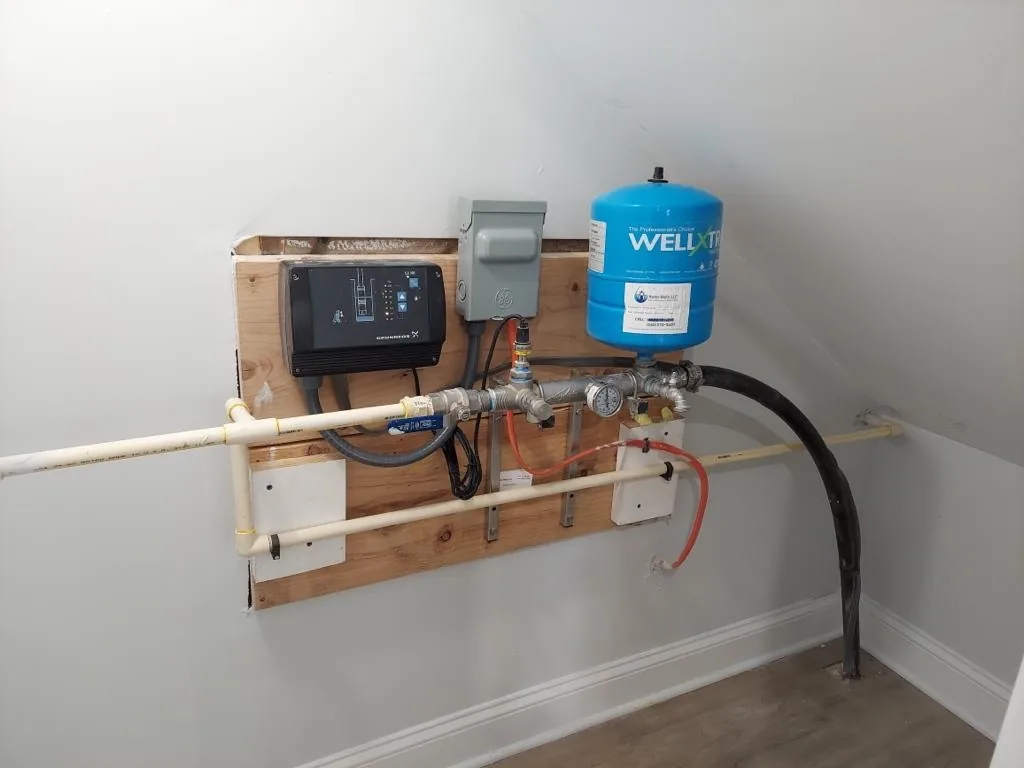
A standard system runs the pump at full speed until a pressure switch shuts it off, and the tank feeds the house until the pump restarts. A constant pressure system varies pump speed through a sensor and controller. One Southern California company pairs 30 to 80 gallon tanks with the first, 2 to 5 gallon tanks with the second.
One supplier’s guide says most switches turn the pump on at 40 psi and off at 60. A Southern California company’s comparison puts the variation near 20 psi, against about 2 psi with constant pressure. On a constant pressure well pump setup, a sensor detects the drop when you open a faucet. The controller, a variable speed drive on the wall, speeds the pump up, then slows it as demand falls.
What does a constant pressure system cost compared with a pressure tank?
A Southern California company’s 2026 table lists $2,000 to $4,000 for a basic system. Its comparison lists $500 to $1,500 for a standard tank system. A national cost guide puts a variable speed system at $3,000 to $7,500 installed, pump included.
Check what each row includes. In the California table, installation is $500 to $1,500 of the total. A new compatible pump is its own line. The supplier’s figure assumes the well pump is coming out anyway. Actual cost will vary by location, the national guide adds. Tank sizes and tank prices sit in our well pressure tank replacement cost guide.
Published ranges, tank setup versus constant pressure
| Setup or part | Published range | Whose figure |
|---|---|---|
| Standard tank and switch system | $500 to $1,500 | Southern California well company |
| Constant pressure system, basic | $2,000 to $4,000 | Southern California well company, 2026 |
| Constant pressure system with monitoring | $3,500 to $5,500 | Southern California well company, 2026 |
| New compatible pump, if needed | $800 to $2,000 more | Southern California well company, 2026 |
| Standard pump and pressure tank, replaced together | $2,500 to $5,000 or more | National water equipment supplier |
| Variable speed pump, controller and small tank, old pump coming out | $3,500 to $4,000 | National water equipment supplier |
| Variable speed system, total installed, any depth | $3,000 to $7,500 | National cost guide, 2025 to 2026 data |
What are the pros and cons of each setup?
A constant pressure system wins on steady pressure and floor space. A standard pressure tank wins on price, with fewer electronics to fail. The steadiness shows most when several fixtures run at once, such as a shower during a toilet flush.
The Southern California company says the small tank frees up space in a well house or basement. Smooth ramping ends the sudden starts that make pipes bang, it adds. It also claims 20 to 30 percent lower pump energy costs and 20 to 30 percent longer pump life. Those numbers are the company’s own claims. The trade-offs, per the sources:
- More electronics to fail, per a national cost guide
- No water until a failed controller is replaced
- Install needs electrical work and proper grounding
- Generator sizing differs from a standard pump
What causes low water pressure on a well, and which setup helps?
On a standard setup, pressure swings as the tank empties and the pump restarts, and constant pressure removes that swing. Neither setup adds water. Run more fixtures than the pump can feed, one supplier’s guide says, and pressure falls on any system.
Pressure that stays low is a different problem. The same guide says many low pressure calls trace to the tank, waterlogged or too small from day one. Others come down to a switch off its setting or a clogged sediment cartridge. Rule those out before buying a controller, it advises. Switches and controls fall under our well pump repair work. If the well itself runs short, hydrofracking a low-yield well may be worth pricing.
Which homes and wells suit a constant pressure system?
Published guides point to busy houses, with two or more bathrooms in use at once. The Southern California company adds large irrigation systems and wells under 10 gallons per minute. It says single-bathroom homes with simple water needs may not need one.
A supplier’s guide says to price one when drilling a new well or when the pump is due for replacement. It also points to a large house or irrigation, once the tank and switch check out. The California company says a controller can keep the pump from outpacing a low-yield well and pulling air. High-yield wells with adequate pressure may not need one, it adds.
Can you convert an existing well to constant pressure in Maryland?
Yes, and in Maryland it is licensed work. Sources differ on whether your pump can stay. A Southern California company says most 3-wire submersible pumps work with a controller, while 2-wire pumps typically do not. A supplier’s guide says the controller needs a matching variable speed pump.
If the old pump cannot stay, the California page budgets an additional $800 to $2,000 for a new one. Older systems may also need a panel upgrade at $300 to $800, it says. Our well pump replacement cost guide covers pump-only prices. Timing matters too. If a five-year-old pump is fine, a supplier’s guide says, you are paying to pull a good pump.
COMAR 26.05.01.01 counts removing and reinstalling pumps and repairing well system equipment as well repair. Pump installers are licensed by the Maryland State Board of Well Drillers for that work, and a Maryland Master Well Driller and a state-licensed pump installer are on the team. Under COMAR 26.04.04.24, the person doing the work is responsible for disinfecting the well afterward, so well disinfection is part of the job.
Deciding between a constant pressure system and a new tank? Call (301) 393-7090. We are open 24/7 and take calls nights, weekends and holidays. Estimates are free and written after a look at the property. You can also send us the pump’s age and what the pressure does.