
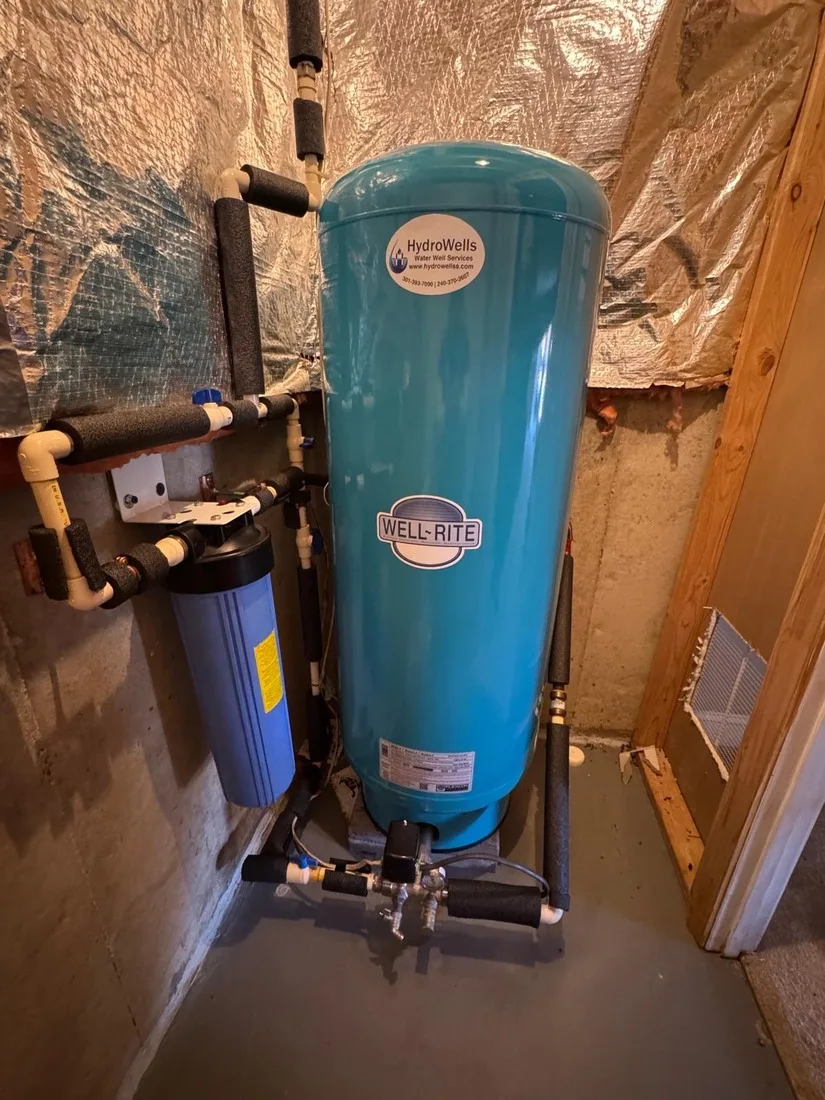
How Much Does Well Pressure Tank Replacement Cost in Maryland?
Published national cost guides put a well pressure tank replacement at roughly $800 to $1,500 installed. Small, easy swaps run closer to $300 to $700. A large tank in a tight spot can reach $3,800. Our pressure tank and switch work covers six Maryland counties.
A pressure tank is the quiet part of a well system. It holds water under air pressure so the pump stays off while you run a tap. When the bladder inside gives out, the pump starts clicking on and off every minute or two. That short cycling wears a pump out early, and it is the usual reason a tank gets replaced.
The ranges below come from published national cost guides. They cover the tank, the switch and fittings, and the labor to swap it. Prices move with tank size, tank grade and how easy the spot is to work in. Pricing your own job takes a look at the tank, the switch and the space around it. We write a free estimate after that visit.
What does a well pressure tank do?
A pressure tank stores water under air pressure so the pump stays off while you run a tap. The pressure switch turns the pump on at a cut in setting and off at a cut out setting. A common pair is 30 and 50 psi. The tank covers demand in between.
Modern tanks use a rubber bladder or a diaphragm. Air sits on one side, water on the other, and the bladder keeps them apart. Older galvanized tanks held air right against the water, so the air dissolved away over time. When a bladder tears, water fills the air side and the tank goes waterlogged. The pump then cycles fast, and fast cycling overheats a pump and cuts its life short.
How do you know when a pressure tank is bad?
Short cycling is the main sign. The pump clicks on and off every minute or two instead of running for a stretch. Pressure that swings while one tap runs points the same way. Left alone, a waterlogged tank runs a pump hot and shortens its life.
Other clues show up around the house. A pump that runs almost constantly, or one that trips a breaker, is working harder than it should. Rust at the base of the tank or a gauge needle that bounces both point to a tank near the end. When the water stops entirely, our emergency well service takes calls around the clock, including nights, weekends and holidays.
Low pressure does not always trace back to the tank. A pump that has lost capacity, or a well whose yield has dropped, can look the same at the faucet. A failing well is a different problem and a different budget, and what a new well costs to drill covers that side. A tech reads the gauge against the switch settings to sort out which part is failing.
- Pump clicks on and off every minute or two
- Water pressure swings while one tap runs
- Faucets spit air after a bladder tears
- Pump runs almost nonstop and the power bill climbs
- Rust at the tank base or a bouncing gauge needle
- A tank that thuds when tapped is full of water
What drives the cost of a pressure tank replacement?
Tank size and grade set most of the price. Next come the parts swapped at the same time, the switch, gauge, relief valve and tee fittings. Then location and labor. A tank in an open basement is a shorter job than one wedged into a crawl space.
Published guides price the tank alone from about $150 to $500 at hardware grade. Pro grade steel and fiberglass tanks on supplier price lists run $1,095 to $2,295. Guides also use a rough benchmark of $10 to $15 per gallon of tank volume. Labor on a like for like swap is commonly $200 to $500. A new pressure switch adds about $50 to $150 when it goes in during the same visit.
Maryland’s well rules shape where the equipment sits. COMAR 26.04.04.21 prohibits pits around the well casing. It also requires the casing to stand at least 8 inches above final grade, with a pitless adapter on water supply wells. So on a modern well the tank lives indoors, usually in a basement or utility room. A tank near the end of its life often turns up on a well inspection before a sale.
Published pressure tank replacement ranges
| Scenario | Published range | What is included |
|---|---|---|
| Standard swap, tank and labor | $800 to $1,500 | Mid size diaphragm tank, old tank hauled out, fittings, labor |
| Small tank, open access | $300 to $700 | A small or hardware grade tank in a spot with room to work |
| Large tank or tight access | $1,500 to $3,800 | An 80 gallon class tank, awkward location, new switch and fittings |
| Tank only, before labor | $150 to $500 hardware grade, $1,095 to $2,295 pro grade | The tank itself, roughly $10 to $15 per gallon of volume |
| Labor only, like for like swap | $200 to $500 | Draining the system, removing the old tank, setting and plumbing the new one |
| Pressure switch at the same visit | $50 to $150 | Switch and the labor to set it while the crew is on site |
| Pump and tank replaced together | $1,500 to $3,000 and up | The pump job plus a new tank, both sized to the well |
What size pressure tank do you need?
Size comes down to drawdown, the water the tank gives back before the pump restarts. A common rule sets drawdown at or above the pump’s output in gallons per minute. Most homes land on a 32 to 86 gallon tank. A 20 gallon tank suits a cabin.
The gallon rating on a tank is bigger than the water you actually get. At a 30/50 psi setting, published drawdown figures land near 30 percent of the tank’s rating. Bigger drawdown means longer pump runs and fewer starts. One sizing guide compares a 10 gallon per minute pump across tank sizes. It counts about 17 cycles an hour on a 20 gallon tank, and about 4 on an 86. Fewer starts is why a bigger tank protects a costly pump.
- 20 gallon tank: about 5.8 gallons of drawdown
- 32 gallon tank: about 9.3 gallons
- 44 gallon tank: about 12.8 gallons
- 86 gallon tank: about 24.9 gallons
- Match drawdown to the pump’s gallons per minute
Should you replace the tank when the pump is replaced?
Often yes, when the tank is old. The crew is already there, the water is already off, and the tank decides how hard the new pump works. Published guides put a pump and tank done together at roughly $1,500 to $3,000 and up.
The pump is the bigger line item. Published guides put a new well pump near $1,785 on average, inside a typical range of $942 to $2,629. Setting depth drives that number. Many wells in the Maryland Piedmont reach hundreds of feet, so drop pipe and wire add up. Our well pump repair and replacement page covers that side of the job. The pump replacement cost guide breaks the ranges down further.
The reverse question is fair too. A tank only a few years old that still holds its air charge can stay in place. A tank at 15 years with a soft bladder will not outlast a new pump. Age and charge are the two things a tech checks before making that call, and the check happens on site with the system running.
Is a constant pressure system a better option?
A constant pressure system swaps the big tank for a variable speed drive. The drive changes pump output to match what the house is using. Pressure stays steady in the shower while the dishwasher runs. Published guides put a basic system at $2,000 to $4,000 installed.
The trade is money for steady pressure. Systems with monitoring run $3,500 to $5,500 in the same guide. The drive unit by itself is $800 to $1,500. These setups pair with a small 2 to 5 gallon expansion tank in place of a 30 to 80 gallon pressure tank, so they free up floor space. For many homes a conventional tank and switch still does the job well. We install constant pressure and standard tank setups.
If your pump is clicking every minute or the pressure keeps dropping, call (301) 393-7090. We are open 24 hours a day, seven days a week. Phone triage on a no water call is free. We serve Montgomery, Frederick, Carroll, Howard, Washington and Baltimore County. Send the details through the contact form and we will set up a free written estimate.